
The Frugal Wizard's Handbook For Surviving Medieval England Review
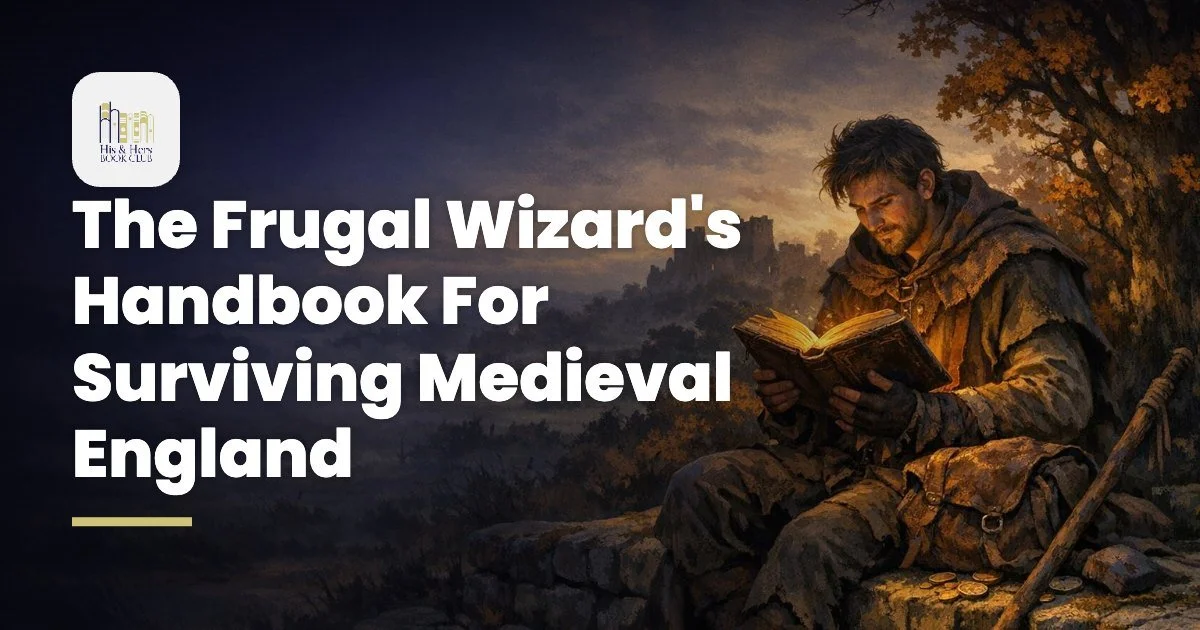
A Big Blue Hardcover and a Three-Month Guilt Trip
There it sat. A big, ridiculous, gloriously blue hardcover with the longest title I have ever seen on a book spine, staring me down from the shelf for a solid three months before I finally caved. I needed a palate cleanser between heavy series, something funny and self-contained, and every instinct I had was screaming "Pratchett." But I knew myself too well. One Discworld book and I'd disappear down that particular rabbit hole for six weeks. So instead, I pulled out Brandon Sanderson's The Frugal Wizard's Handbook For Surviving Medieval England and figured I had nothing to lose. If you want a quick primer on the man himself, there are some genuinely surprising facts about Brandon Sanderson worth knowing before you dive in.
Guys, I was not prepared for how much I was going to love it.
5/5 stars. No caveats. Cherry on top. Let's get into it.
The Frugal Wizard's Handbook For Surviving Medieval England: Summary
The premise is wonderfully daft. In a future where travel to alternate dimensions has been invented and promptly commercialised to death, you can book a trip to a parallel version of Medieval England the same way you'd book a package holiday to Majorca. Some people use their purchased dimensions to live out power fantasies. Others use them as convenient staging grounds for interplanetary smuggling operations. Good old humanity.
Our main character, who we'll call the "wizard" for now, wakes up in Anglo-Saxon England with essentially no memory of who he is, where he came from, or why he's there. He is biologically enhanced, demonstrably overpowered compared to the locals, and completely clueless. As the story unfolds, fragments of his past trickle back, and the picture they paint is... not flattering.
The one item specifically designed to help him navigate all this, the eponymous handbook itself, has been half-incinerated on arrival. He's left piecing together survival advice from scorched pages that mix genuinely useful tips with hilariously tone-deaf futuristic marketing copy.
Meanwhile, the locals have decided he's basically a god. And the people from his own dimension who've tracked him down? They're not there to help.
It is funny, warm, tightly plotted, and moves at a cracking pace. The comedy lands because Sanderson genuinely commits to the bit rather than winking at the audience every five minutes.
What Makes This Book Genuinely Special
The First-Person Voice Is a Revelation
Almost everything Sanderson writes uses a close third-person perspective with multiple viewpoints, which suits his epic, interlocking Cosmere projects perfectly. This book is written in first person, and the effect is startling. It feels loose, immediate, and funny in a way his other work rarely allows itself to be. You get the sense Sanderson simply sat down and wrote something for the sheer pleasure of it, without a seventeen-book plan hanging over his shoulder.
That energy is infectious.
The Probability Magic System
Sanderson is rightly famous for building hard magic systems, where the rules are clearly defined and the consequences of breaking them are real. This one runs on probability manipulation expressed through runes. It's not tied to any cosmic force or divine will; it simply nudges the odds. Which means that yes, spontaneous combustion is an actual, statistically plausible threat in this world, and Sanderson milks that fact for everything it's worth. It also means the Norse/Anglo-Saxon mythology woven into the story has a genuinely interesting in-universe explanation rather than just being window dressing. If you enjoy this kind of inventive rule-set, our roundup of books about wizards and magic systems has plenty more to keep you busy.
The Anglo-Saxon Setting Is Seriously Underused Everywhere Else
Medieval England in fiction almost always means one of two eras: the Roman occupation or the late medieval period of knights and tournaments and sweeping cloaks. The Anglo-Saxon period, that fascinating window right before the Viking Age reshaped everything, gets almost no attention. Sanderson consulted a subject matter expert to get the cultural details right, and it shows. The village dynamics, the religious tensions between old belief systems and Christianity, the specific social hierarchies: all of it feels grounded rather than generic. If this corner of history has piqued your interest, our guide to Norse mythology and early medieval settings is a natural next stop. It's a genuinely impressive research backbone for a book that is also making jokes about futuristic travel brochures.
The DCC Connection Nobody Talks About Enough
If you loved Dungeon Crawler Carl by Matt Dinniman and you're hunting for something with a similar energy, nearly every recommendation list will point you straight at another sprawling LitRPG series. This book is the answer those lists keep missing. A biologically enhanced individual with HUD overlays and system menus dropped into a world that treats him as mythological? Locals slowly realising they're essentially NPCs in someone else's game? A cast of gloriously strange supporting characters? It's all here, in a tidy, standalone package. Sanderson's other shorter works, including Sanderson's other shorter works like Sunreach, show just how comfortable he is when he steps away from doorstop-sized epics.
The Pages, the Format, and What to Expect
The hardcover edition sits at around 300 pages, illustrated throughout by Steve Argyle, whose artwork adds genuine charm to the in-universe "handbook" sections. Those illustrated interstitials, formatted as actual pages from the Frugal Wizard's marketing handbook, are some of the funniest writing in the book. The audio edition is also widely praised for its narration if that's your preferred format.
The length is deliberately lean by Sanderson standards. This is not The Way of Kings. You can finish it in a couple of comfortable sittings, which is exactly what a palate-cleanser should be.
A Few of the Best Moments (Without Spoiling Them)
The sequence where our protagonist attempts to explain dimensional travel to a suspicious Anglo-Saxon chieftain is one of the funniest scenes Sanderson has ever written. The chieftain's logic is completely unassailable from his own worldview, and watching the "wizard" squirm around it without the ability to say anything remotely truthful is genuinely delightful.
There's also a running thread about what the handbook's marketing copy actually promises versus what the dimension turns out to deliver, and it escalates beautifully across the whole novel. If you've ever read a travel brochure and then looked around at your actual destination, you'll feel very seen.
And the ending. Without saying anything specific: it earns its emotional beat. For a book that spends most of its runtime being funny, the final act has some real weight to it, and Sanderson lands it cleanly.
Is This the Right Book for You?
Read this if you want a standalone that asks nothing of you in terms of prior reading. Read it if you've been meaning to try Sanderson but felt intimidated by the sheer mass of the Cosmere. Read it if you finished Dungeon Crawler Carl and your brain needs something that hits a similar nerve. Read it if you've read every Sanderson epic and want to see what he does when he's just... playing.
Honestly, read it if you just want to laugh. That's reason enough. And if you're at a point where picking up any book feels like a chore, this is exactly the kind of thing we recommend when people ask us how to get out of a reading slump: short, funny, completely self-contained, with zero homework required.
If this review has you curious about more Sanderson deep-dives, or you fancy seeing what happens when Alex and Stani (who almost never agree on what to read) try to find common ground on a book like this, the His & Hers Book Club newsletter is exactly that kind of chaos, delivered free to your inbox. Subscribe at hisandhersbookclub.com for new reviews and reading guides as they go up. You can also follow along on Pinterest and Instagram at @hisandhersbookclub, where the disagreements are very much ongoing and fully documented.
Frequently Asked Questions
Is The Frugal Wizard's Handbook For Surviving Medieval England part of the Cosmere?
No, it is completely separate. The Cosmere is Sanderson's interconnected fantasy universe spanning series like Mistborn, The Stormlight Archive, Warbreaker, and others, all sharing the same underlying cosmology. The Frugal Wizard's Handbook is set in its own standalone sci-fi multiverse and has no connection to those stories whatsoever. You won't miss a single in-joke or lore beat by reading it without any Cosmere knowledge. If you do want to explore that side of his work, our review of Mistborn: Secret History is a good place to see how deep that rabbit hole goes.
What is a Brandon Sanderson Secret Project, and where does this book fit in?
During the pandemic, Sanderson wrote four novels in secret, entirely outside his existing publishing contracts. He revealed them via a record-breaking Kickstarter campaign and released them over the following year. The Frugal Wizard's Handbook was Secret Project #2. The campaign is widely regarded as one of the most successful publishing crowdfunds ever run.
Does The Frugal Wizard's Handbook For Surviving Medieval England have a sequel?
As of this writing, there is no announced sequel. Sanderson has described it as a standalone story, and given that the narrative wraps up satisfyingly, it reads as intentionally complete. That said, Sanderson is famously prolific, and the world has enough texture that a return visit would not feel forced if he ever chose to revisit it. Check his official site or newsletter for any updates on future projects.
How long is the book, and is it a quick read?
The hardcover edition runs to approximately 300 pages, which is compact by Sanderson's usual standards. Most readers finish it in two to four sittings. The illustrated handbook pages interspersed throughout the chapters add to the page count but never slow the pace; if anything, they're some of the quickest and most entertaining reading in the whole book.
Are there any memorable quotes from the book?
The funniest lines tend to come from the in-universe handbook itself, where the futuristic marketing copy collides with obviously dangerous medieval realities in ways that are very quotable. The main narrative also has some quietly sharp observations about identity and what we assume about ourselves when memory is stripped away. Specific quotes are widely shared in reader communities online, and a search of the title in any book-focused forum will turn up plenty of fan favourites without spoiling the plot.


Dungeon Crawler Carl book 6, The Eye of the Bedlam Bride, reviewed: what happens, why the series keeps getting better, and whether it's worth reading. Honest fan take.