
5 Oscar Wilde Books That Still Feel Modern
Some classic writers feel like history homework. From their prose to their views and beliefs, it feels like trying to understand human experience through a prism that seems almost alien to modern audiences. And while we can learn to understand them, I’ve often wondered what would some of these authors think of the world today, if they were suddenly dropped into it. Would they adapt or would they be driven mad by what they saw? I tend to favour the latter possibility for most.
That being said, there are a few exceptions, who I think would absolutely thrive in a modern setting, the chief of whom is Oscar Wilde. He is just one of those unique authors who feel like they’d be right at home joining your friends’ group chat, reading two messages, and quietly understand everyone’s secrets and motivations.
His works feel modern because he touches upon universal parts of the human experience that has remained relatively unchanged despite our vast technological and ideological progress.
The below is not my attempt at listing his full bibliography or best reading order. I’ve already done that before in our Oscar Wilde Books in Order guide.
Today, I am to answer one simple but precise question:
Which Oscar Wilde books still feel the most modern, right now?
Here is the short answer, which - in my opinion - most readers will actually enjoy:
The Picture of Dorian Gray
The Importance of Being Earnest
An Ideal Husband
The Happy Prince and Other Tales
The Soul of Man under Socialism
Each one speaks directly to concerns that still keep people awake: image, performance, power, money, compassion, control. Let’s treat them not as museum pieces, but as books that still know exactly where to poke.
Affiliate Disclaimer: This article may contain affiliate links for which, through no additional cost to you, we may receive compensation. For more information about our affiliate use, check our Disclaimer page.

1. The Picture of Dorian Gray: Image, guilt, and the urge to reset your life
Best for: readers who like dark psychology, aesthetics, and stories that stare straight at self-sabotage.
Published first in Lippincott’s Monthly Magazine in 1890 and then expanded into a novel in 1891, The Picture of Dorian Gray tracks what happens when a beautiful young man makes a wish: that a portrait will age and record his corruption so his face never will.
That premise alone is modern. Dorian gets to live like an influencer with a private server for all the ugly consequences.
Where the book really keeps its bite, though, is not just in the horror of the portrait. It is in the way Dorian learns to treat his own humanity as a nuisance: the idea that nothing can truly hurt Dorian except Dorian himself. The world cannot scar him. Time cannot mark him. The only real danger comes when he finally looks at what the portrait has become and decides he cannot live alongside that knowledge any longer.
Most surface readings stop at “he pays for his sins.” There is another way to read that final stabbing of the portrait. It can look like panic, yes. It can also look like a very last, very desperate bid for redemption, where he knows exactly what the knife will do. His body becoming monstrous while the portrait returns to its original purity can feel like a violent absolution: the cost is total, but for one instant, the true Dorian is finally honest.
That tension is why the novel still feels relevant in a culture obsessed with looking fine while quietly falling apart.
If you want plot details, themes, and book club questions, you can find them in our The Picture of Dorian Gray Summary, Themes & Ending article.
Recent theatre and criticism keep underlining its relevance too, especially in queer history and in conversations about youth worship and surveillance of desire.

2. The Importance of Being Earnest: Performing a personality
Best for: readers who want to laugh and then realise the joke is on them a little.
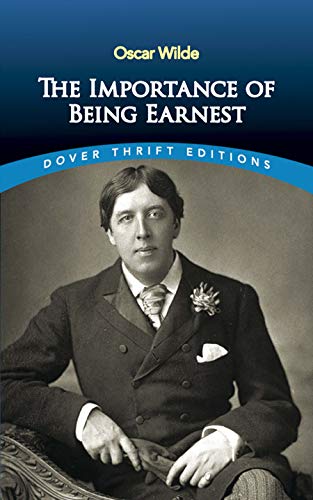
First performed in London on 14 February 1895, The Importance of Being Earnest was billed as “a trivial comedy for serious people.” On the surface, it is a farce about two men who pretend to be called “Ernest” so they can dodge responsibilities and charm the women they want.
Underneath, it is about something that feels incredibly current: curated identity.
Everyone in the play edits themselves. Names are chosen for the feelings they create, not for truth. Personal histories get wiped, rebranded, or left conveniently vague. There is a constant negotiation between who people are and who they can get away with being in front of an audience.
If you have ever sat in front of a profile screen and tried to decide which parts of your life are “you” and which are better left off, you already understand this play.
Recent revivals lean openly into its queer subtext, with casting and staging that treat hidden desire as part of the architecture rather than a footnote. That feels right for a play that came out weeks before Wilde’s trials and imprisonment for “gross indecency,” when the gap between public politeness and private life could be deadly.
For a modern reader, The Importance of Being Earnest works as:
a comedy that still lands, line by line
a study of how names, reputations, and “vibes” shape attraction
a snapshot of the moment just before Wilde’s public world collapses around him
If you want more context on where this play sits in Wilde’s career, there is a whole section dedicated to it in Oscar Wilde Books in Order.
3. An Ideal Husband: Political scandal and the performance of virtue
Best for: readers fascinated by politics, blackmail, and people who want to be good while staying wildly inconsistent.
Written in the mid-1890s and first produced in 1895, An Ideal Husband revolves around Sir Robert Chiltern, a politician with a spotless public image and a secret that could destroy his career. A visiting blackmailer knows that his wealth and status rest on a corrupt act from his past.
Sound familiar?
The play feels modern because it takes questions that still circulate today:
Can someone be both compromised and genuinely principled?
Who decides when a past mistake cancels a person?
How much of “virtue” is a shared story people agree to protect?
In the play, Wilde puts pressure on every character’s certainty. Lady Chiltern wants a husband who is morally perfect. Sir Robert wants his life, career, and marriage without coming clean. Mrs Cheveley wants power and revenge. Lord Goring floats around the edges making jokes and quietly forcing everyone to confront what they are doing.
Modern audiences are used to political scandals, leaked messages, and public apologies that may or may not be sincere. Watching those same dynamics play out in Wilde’s drawing rooms is weirdly satisfying. The language is Victorian. The patterns feel very familiar.
If your book club enjoys talking about public ethics, An Ideal Husband works well paired with our 1984 Book Summary and Review or our Animal Farm characters and quotes article. Different settings, same uneasy questions about power and story control.

4. The Happy Prince and Other Tales: Fairy tales that do not flinch
Best for: readers who like short, emotional stories, and parents or teachers who want literature that respects children’s intelligence.
Published in 1888, The Happy Prince and Other Tales gathers five stories that often get labelled as children’s literature. You get “The Happy Prince,” “The Nightingale and the Rose,” “The Selfish Giant,” “The Devoted Friend,” and “The Remarkable Rocket.”
On a first read, they are simple and clear. On a second read, they are sharper than many contemporary “issue books.”
The modern edge sits in how Wilde deals with:
charity that keeps hierarchies in place
people who love beauty more than they love actual people
sacrifice that no one sees
the gap between official goodness and real kindness
Take “The Selfish Giant.” The plot is straightforward. A giant chases children out of his garden and pays an emotional price for shutting them out. On the surface, it is a story about sharing. Underneath, it is about how isolation damages the person who enforces it.
Or “The Nightingale and the Rose.” A nightingale literally gives its life to create a perfect red rose so a student can impress a girl. He ends up dismissed, and the rose is thrown away. That is a far more honest depiction of unrecognised emotional labour than many modern romances manage.
In a world where people burn out from giving more than they can afford, Wilde’s tiny tragedies feel very current.
If you want more children’s classics that touch upon deep questions of life, I wholeheartedly recommend you check out The Wind in the Willows by Kenneth Grahame.

5. The Soul of Man under Socialism: Wilde without the costume
Best for: readers who like essays, political thought, and big conversations about work, money, and freedom.
Written in 1891, The Soul of Man under Socialism reads less like a party speech and more like Wilde’s serious voice unfiltered. In this essay, he argues that a society built on poverty and charity wastes human potential, and that real individualism needs material security to exist at all.
The piece is often described as libertarian socialist or anarchist in its leanings. Wilde is suspicious of systems that turn “helping the poor” into a way for the wealthy to feel holy while keeping the structure exactly the same. He imagines a future where people are free from the grind of survival, and where that freedom lets them create, think, or simply exist without constant fear.
Several parts feel eerily on point for current conversations:
the criticism of “performative” charity
the idea that constant crisis work stops people from addressing root causes
the belief that art and creativity are not luxuries, but basic expressions of a full life
For anyone who enjoys non-fiction that challenges your assumptions, this essay shows a side of Wilde that fits right alongside modern social theory threads.
It also pairs well with De Profundis, the long letter he wrote from prison in 1897, where he confronts his relationship with Lord Alfred Douglas and reflects on suffering, humility, and self-knowledge.
You can think of The Soul of Man as Wilde’s theory of how people should live, and De Profundis as his report from the wreckage.

A quick “start here” reading bundle
If you want a three-book mini arc that feels cohesive:
The Importance of Being Earnest
The Picture of Dorian Gray
The Soul of Man under Socialism
That trio gives you social performance, private consequence, and the philosophical spine behind the sparkle.
Which Oscar Wilde book should you read next?
Pick the one that matches your current reading mood.
Start with The Picture of Dorian Gray.
Pick The Importance of Being Earnest.
Read An Ideal Husband.
Go for The Happy Prince and Other Tales.
Try The Soul of Man under Socialism, then De Profundis.
Book club angles that avoid the obvious
If your group wants fresh discussion beyond “vanity is bad” and “Victorians were dramatic,” try this:
The Picture of Dorian Gray: Is the portrait a punishment, a conscience, or a chance at self-knowledge?
The Importance of Being Earnest: Which lie is treated as the most socially acceptable, and why?
An Ideal Husband: What counts as a redeemable public sin?
The Happy Prince: Who benefits when compassion becomes a performance rather than an action?
The Soul of Man Under Socialism: Where does individual freedom clash with social responsibility in the modern world?
For a broader prompt library that you can use for your book club meetings, check out our Book Club Discussion Questions guide.
Read next on His and Hers Book Club:
FAQ: Oscar Wilde and modern readers
Which Oscar Wilde book feels most like today?
For most readers, The Picture of Dorian Gray feels closest to current life. Its focus on image, reputation, and hidden damage maps very neatly onto social media culture and the pressure to look fine while losing your grip inside.
Is Oscar Wilde still worth reading if I do not usually like classics?
Yes. The Importance of Being Earnest is short, funny, and easy to stage in your head, which makes it a friendly entry point. The Happy Prince and Other Tales is another gentle way in if you prefer short stories.
Which Wilde book is best for a book club?
If your group likes big themes and a lot to argue about, choose The Picture of Dorian Gray or An Ideal Husband. If you want laughter with sting, choose The Importance of Being Earnest and pair it with our Book Club Discussion Questions article.
Where can I read Wilde’s essays for free?
Both The Soul of Man under Socialism and De Profundis are out of copyright and available through online archives such as Project Gutenberg and other reputable classics collections.


Dungeon Crawler Carl book 6, The Eye of the Bedlam Bride, reviewed: what happens, why the series keeps getting better, and whether it's worth reading. Honest fan take.