
How to Read Faster (Without Losing the Joy of the Story)
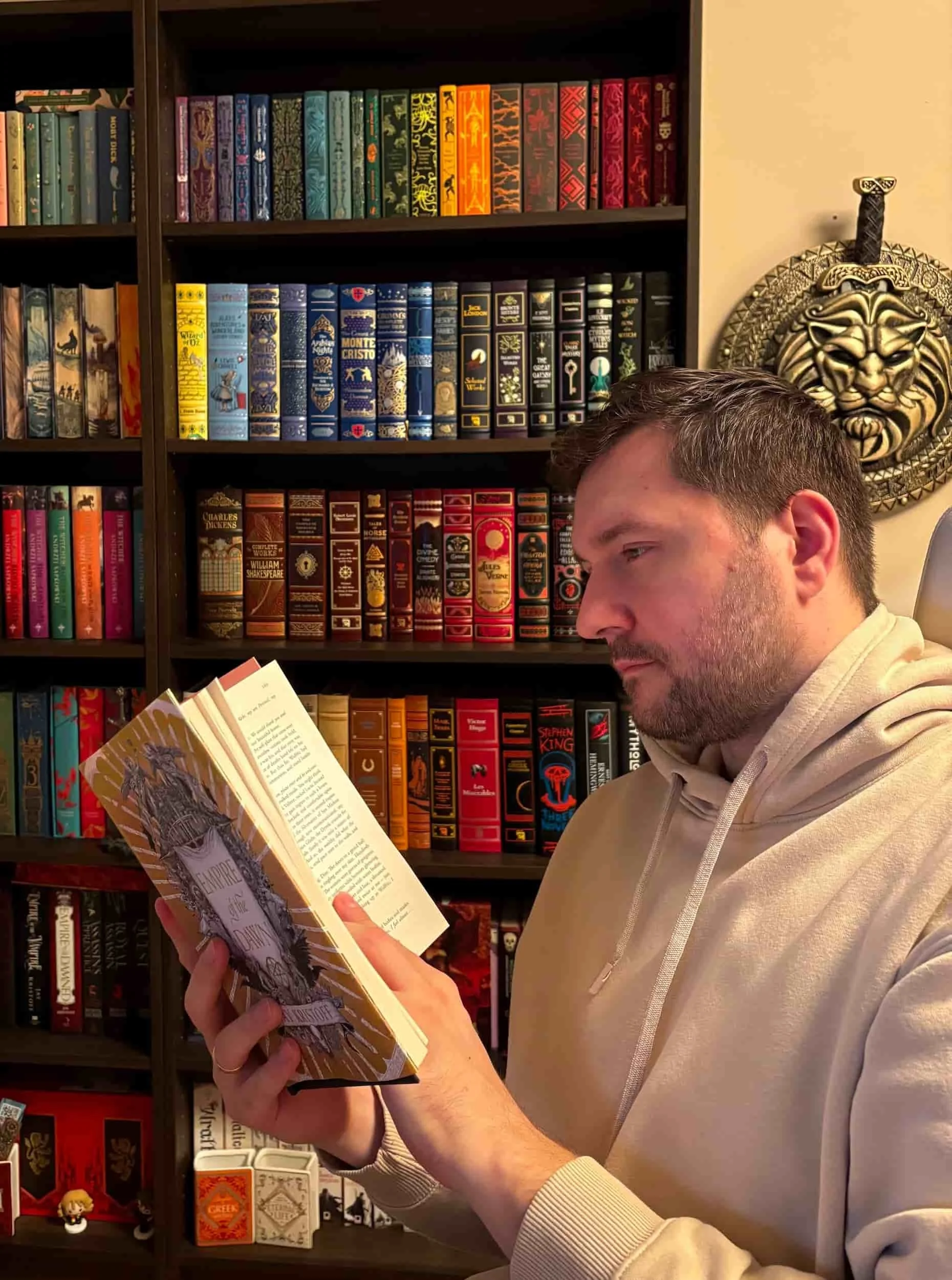
I love big books and I cannot lie. But with two kids and two businesses, I had to learn how to read them efficiently.
I like to think of myself as a relatively fast reader. Give me a chunky Epic Fantasy novel, and I can usually polish it off in a day or two.
But here is the reality check: I am not a machine. I am a father of two beautiful (and very energetic) boys, and I run two companies alongside my wife, Stani. My "reading time" is often stolen in 15-minute chunks between diaper changes and Zoom calls.
I wasn't born a fast reader. It took me literal years to get to this point. And while I am happy with my speed, I also know there are readers much faster than me. And that’s okay.
If you are staring at your TBR pile with anxiety, wondering how you’ll ever get through it, this guide is for you. Here is how I trained my brain to read faster, comprehend more, and actually finish those 800-page doorstoppers.
At a Glance: 8 Ways to Increase Reading Speed
Stop Subvocalizing: Train your eyes to see words, not say them.
Use a Pacer: Use your finger to guide your eyes and reduce wandering.
Stop Regressing: Trust your brain and stop re-reading sentences.
Pick "Fast" Books: Train on thrillers or YA, not dense classics.
Expect Style Shock: Accept that older books will naturally be slower.
The 15-Minute Sprint: Focus on short, intense bursts of reading.
Remove Phone Friction: Leave your phone in the other room.
Switch to Audio: Give your eyes a rest and listen at 1.5x speed.
The Golden Rule: Joy > Speed
Before we dive in, let’s set the ground rules. If you are trying to speed-read just to hit a number on Goodreads, stop. You are reading for joy, not for a class assignment.
The goal isn't to skim the book so fast you miss the plot twists; the goal is efficiency. It’s about removing the friction between your brain and the page. (Check out our guide on How to Get Out of a Reading Slump if you feel like reading has become a chore).
1. Break the "Subvocalization" Habit
For me, the toughest thing to learn was how to silence the narrator in my head. Most of us are taught to read by reading aloud. As adults, we still do this silently: we "mouth" or "hear" every single word in our heads. This is called subvocalization.
The Problem: You can only speak about 150 words per minute. But your brain can process visual information much faster. If you are saying every word in your head, you are putting a speed limit on your brain.
The Fix: You have to train your eyes to snap a "picture" of a group of words.
Try this: Instead of looking at the first word of a line, look at the middle of the line. Try to take in the whole phrase at once. It feels weird at first, like you are skimming, but eventually, your brain adapts. It took me years, but now it is my default setting.
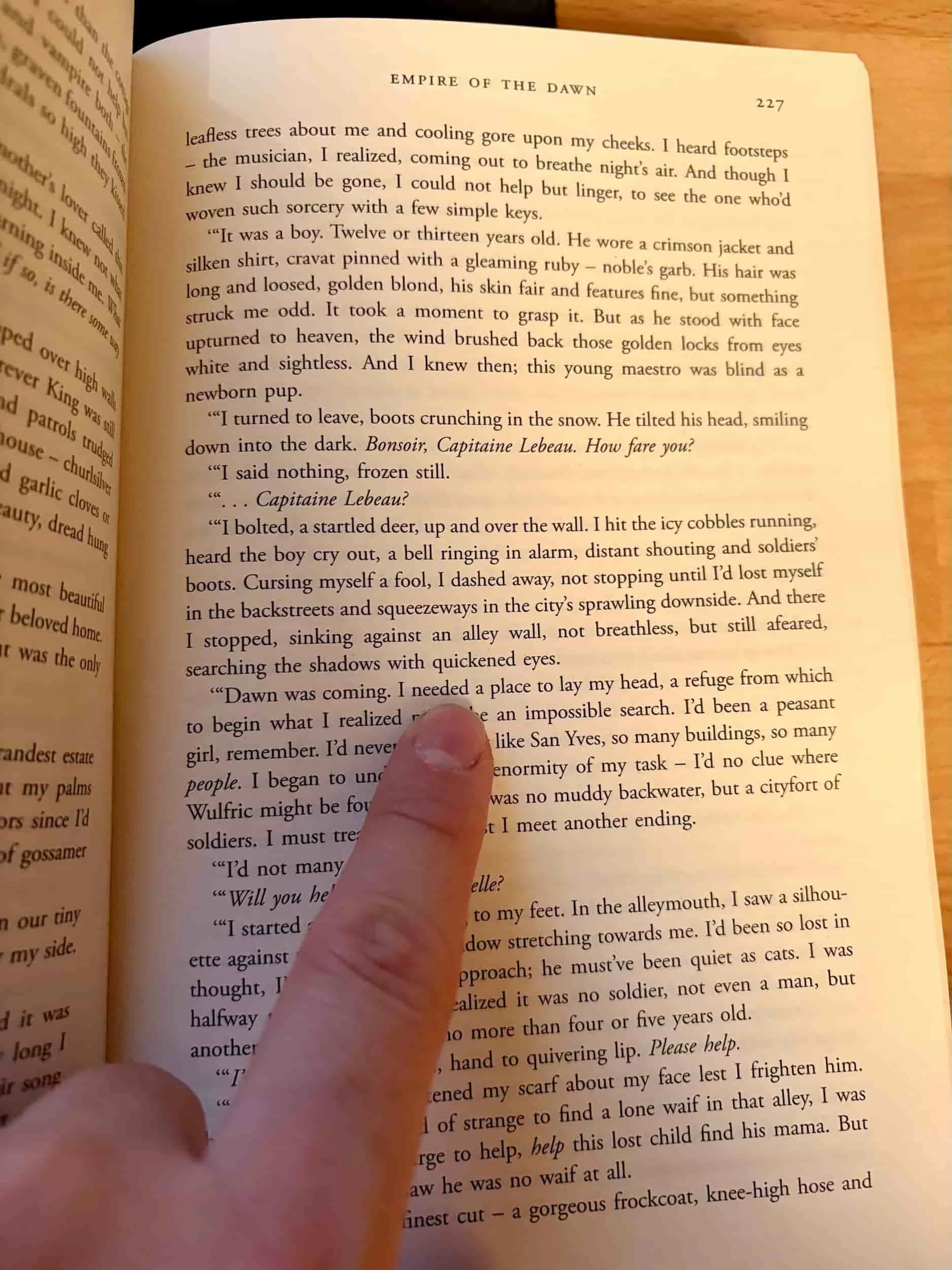
The oldest trick in the book: Using a pacer prevents your eyes from wandering and increases speed instantly.
2. Use a Pacer (The Finger Method)
Your eyes are naturally jittery. They like to skip back, look around, and lose their place. This "visual wandering" kills your speed. The simplest way to fix this is to use your finger, a pen, or a bookmark as a pacer. Run it underneath the line you are reading at a steady speed. Your eyes will naturally follow the movement.
It forces your focus forward and prevents you from unconsciously re-reading the same sentence three times.
3. Stop the "Regression" (Trust Your Brain)
Have you ever read a sentence, doubted yourself, and immediately went back to read it again? That is called regression. 90% of the time, you did understand it, but your brain is just being insecure. This habit doubles your reading time.
The Fix: Unless you are truly lost, do not go back. Force yourself to keep moving forward. Usually, the context of the next sentence will clarify whatever you thought you missed.

Not all miles are the same. Training your speed on The Inheritance Games is different than tackling big fantasy books or classics.
4. Choose the Right "Training" Books
If you decided to start running today, you wouldn't sign up for an Ultra-Marathon through the mountains. You would jog on a flat track. The same applies to reading speed.
When you are practicing these techniques, start with straightforward prose.
Good for Training: Sarah J. Maas, thrillers, or Young Adult fantasy. The sentences are punchy and the plot moves fast.
Bad for Training: R.F. Kuang, Tolkien, or dense philosophy.
If I pick up an ACOTAR book, I can fly. If I pick up Babel by R.F. Kuang, I have to slow down. The prose is denser, the footnotes are essential, and the concepts require more processing time.
5. Respect the "Style Shock"
Don't get discouraged if you can't immediately apply your newfound speed to every book. Reading Sherlock Holmes requires a different gear than reading The Inheritance Games.
If you don't believe me, try picking up some Elizabethan or Victorian fiction. When I read classics, my speed drops by half. And that is fine! Older literature uses complex sentence structures that our modern brains aren't used to. You have to make the same effort to improve there as you did with modern fiction.
6. The "15-Minute Sprint" Rule
I run two companies. I don't have 4 hours a day to sit and read. Many people think reading faster means "reading for longer." Actually, it's about consistency.
I read faster when I know I only have 15 minutes. It creates a "sprint" mentality. If I try to read for 2 hours, my mind wanders. If I have 15 minutes before the kids wake up, I am laser-focused.
7. Eliminate the "Phone friction"
This sounds obvious, but it is the #1 killer of reading speed. If your phone is next to you, your brain is splitting its processing power. Even if you don't look at it, you are thinking about looking at it. My Rule: When the book is open, the phone is in the other room.
8. Switch Mediums (Audiobooks count!)
Sometimes, your eyes are just tired. If I have hit a wall visually, I switch to Audiobooks. It keeps the narrative moving even when I'm driving or doing dishes. It trains your brain to process the story at the narrator's speed (which you can bump up to 1.5x if you’re feeling brave!).
Final Thoughts
Reading faster isn't a magic trick; it's a muscle. It takes time to build. Be patient with yourself. Remember, the point isn't to rush to the end of the book; the point is to have more time to live inside the world the author created.
Frequently Asked Questions
What is the average reading speed (words per minute)?
The average adult reads about 200 to 250 words per minute (wpm). A "fast" reader typically hits around 300-400 wpm. Anything above 500 usually involves some level of skimming.
Does reading faster reduce comprehension?
It can, if you aren't careful. That is why I recommend "training" on easier books first. The goal is to find the "sweet spot" where you are reading as fast as possible without losing the movie in your head.
How do you read faster with comprehension?
The "Pacer Method" (Tip #2) is the best for this. It keeps your eyes moving but ensures you actually look at every line, preventing you from accidentally skipping important details.



Dungeon Crawler Carl book 6, The Eye of the Bedlam Bride, reviewed: what happens, why the series keeps getting better, and whether it's worth reading. Honest fan take.